Juche Tower
Overlooking the Taedong River, the Tower of the Juche Idea was built in 1982 to honor President Kim Il Sung and the DPRK’s official state ideology: the Juche Idea.
Guide Content
A Monument to the DPRK's Core Philosophy
Rising high above the Taedong River, directly facing Kim Il Sung Square, the Tower of the Juche Idea (주체사상탑/主體思想塔) is one of the most iconic landmarks in Pyongyang. Built in 1982 to commemorate President Kim Il Sung's 70th birthday, the tower honors the DPRK's official state ideology: the Juche Idea.
What Is Juche?
Juche, pronounced "joo-cheh" (if it helps, picture Che Guevara in a yarmulke), is often loosely translated as "self-reliance" or described as "Marxism-Leninism adapted to Korean conditions." While there's some truth to these interpretations, they fall short of capturing the full depth of the concept. While the Juche Idea (주체사상/主體思想) does in fact emphasize self-reliance, independence, patriotism, and nationalism, it is not simply the sum of these components. The meaning of Juche is very nuanced, and the more you understand it, the harder it is to capture fully in translation without losing its cultural meaning.
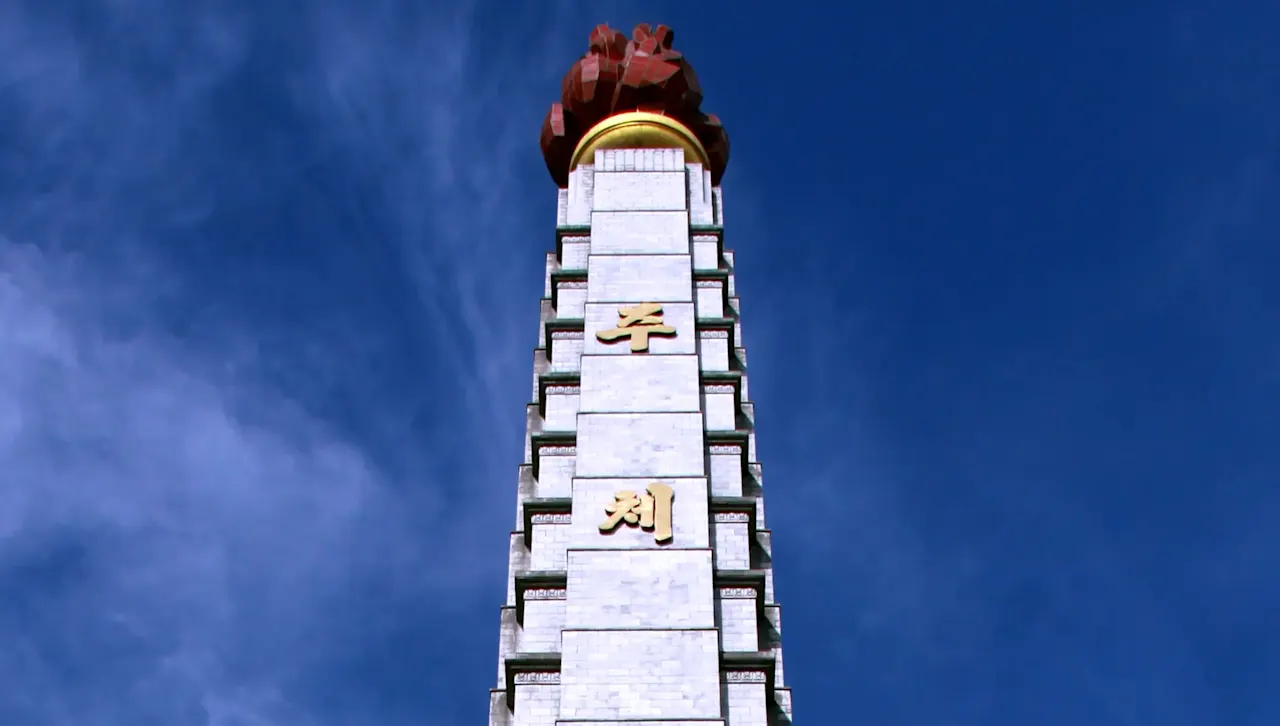
Let's break down the word Juche (주체/主體):
Ju (주/主): main
Che (체/體): body
This can be understood as "the main body," "the subject," or the "core entity."
While the Juche Idea as a political philosophy is a distinctive Korean development, the philosophical idea of "the main body" actually traces back to Chinese philosophy. The characters that are pronounced juche in Korean, 主體, are read as zhuti in Standard Chinese (like how "1" is "one" in English but "uno" in Spanish). Similar to how English words shift meaning in different contexts (e.g.: "work" in physics vs. a 9-to-5 job), zhuti has different meanings across Chinese thought:
- In Confucianism, it's about becoming a "body of virtue"—owning your moral choices in society;
- In Daoism, it's about flowing with the natural rhythm of the universe;
- In modern political theory, zhuti is interpreted as as "subjectivity:" the people as active shapers of history.
This is why some translate Juche as self-reliance, while others might translate it as independence. It's also translated as subjectivity, but without understanding what this subjectivity is of, the meaning is lost. The "subjectivity" of the Juche Idea does not mean the belief that subjectivity can override objectivity.
Juche, in the Korean sense, is similar to the Confucian idea of zhuti, but applied to the collective and the leader, and the modern political definition of zhuti is clearly found in the teaching that man is the master of his destiny. According to the Juche Idea, man is the master of his destiny, but this applies on the collective level: individual subjectivity is subsumed within and finds expression through loyalty to the collective, namely the Korean people, and the embodiment of the people's will, consciousness, and subjectivity, which is the country's leadership. However, this does not imply that the leadership is unbound by the limitations of the natural universe, nor does it suggest that the leader is a god. Rather, it means that when objective conditions arrive for some development to arise, it is still up to human agency to pull the trigger and seize the opportunity. Juche is therefore not an idealistic philosophy divorced from real-world conditions, as some may claim, but one that stresses the power of conscious human action, led by the collective, to shape the future.
Here's a less political example of subjectivity in relation to objectivity that everyday people can relate to: if two people are interested in each other, the potential for a relationship exists (that's the "objective condition"). But nothing happens unless someone says "hey"—that's the Juche moment!
The Juche Tower is a giant monument to all this: self-determination, resilience, and the clarity that the Korean people are the captains of their ship: the Democratic People's Republic of Korea.
Design and Structure
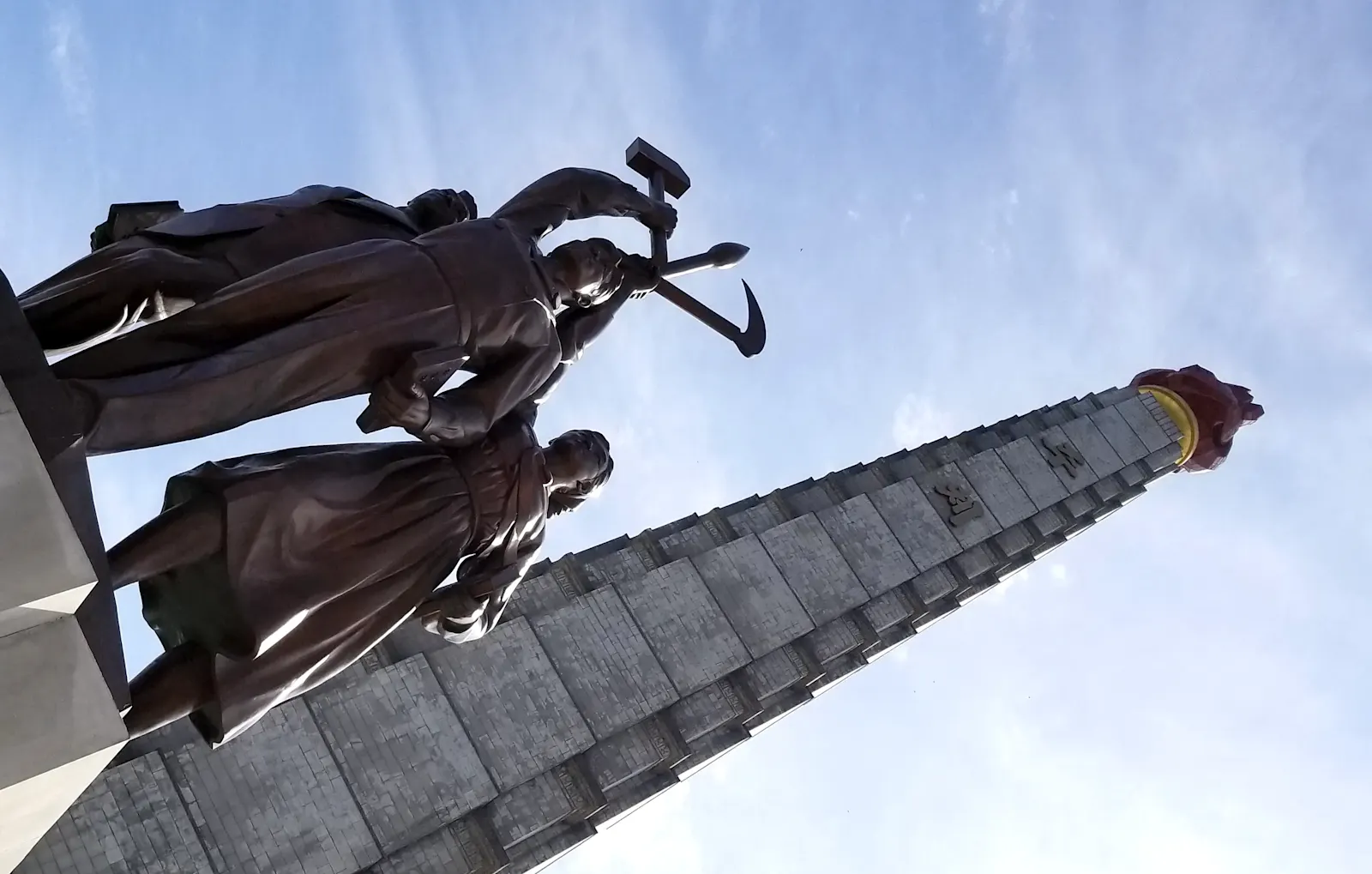
The tower stands at 170 meters tall, making it the second-tallest stone tower in the world. It consists of 25,550 granite blocks, one for each day of Kim Il Sung’s life up to his 70th birthday. At the top sits a red flame that is illuminated at night, representing the eternal and guiding light of Juche. Flanking the base of the tower is a trio of dynamic bronze sculptures: a worker with a hammer, a farmer with a sickle, and an intellectual with a writing brush.
Together, the tower and the sculptures represent the three pillars of socialist society working in unity under the Party guided by Juche. Also surrounding the tower are additional bronze groupings portraying education, industry, and revolutionary struggle, all contributing to the monument's sweeping ideological message.
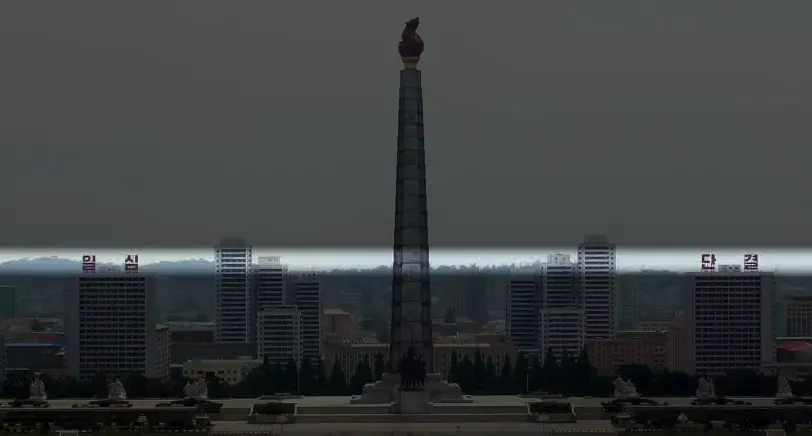
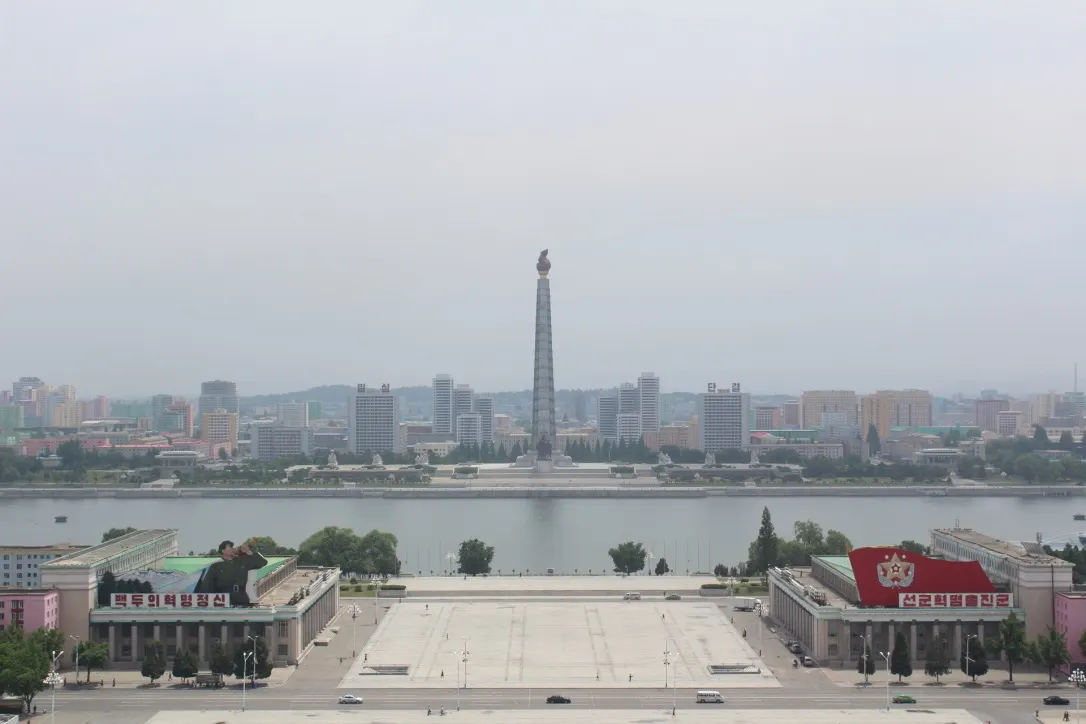
When viewed from across the Taedong River on Kim Il Sung Square, the Juche Tower is flanked by a building with two Korean characters on each side. The characters on the left building read "ilsim" (일심) while the ones on the right building read "dangyeol" (단결), forming the phrase "ilsim-dangyeol" (일심단결/一心團結), which means "single-hearted unity."
Visiting the Juche Tower
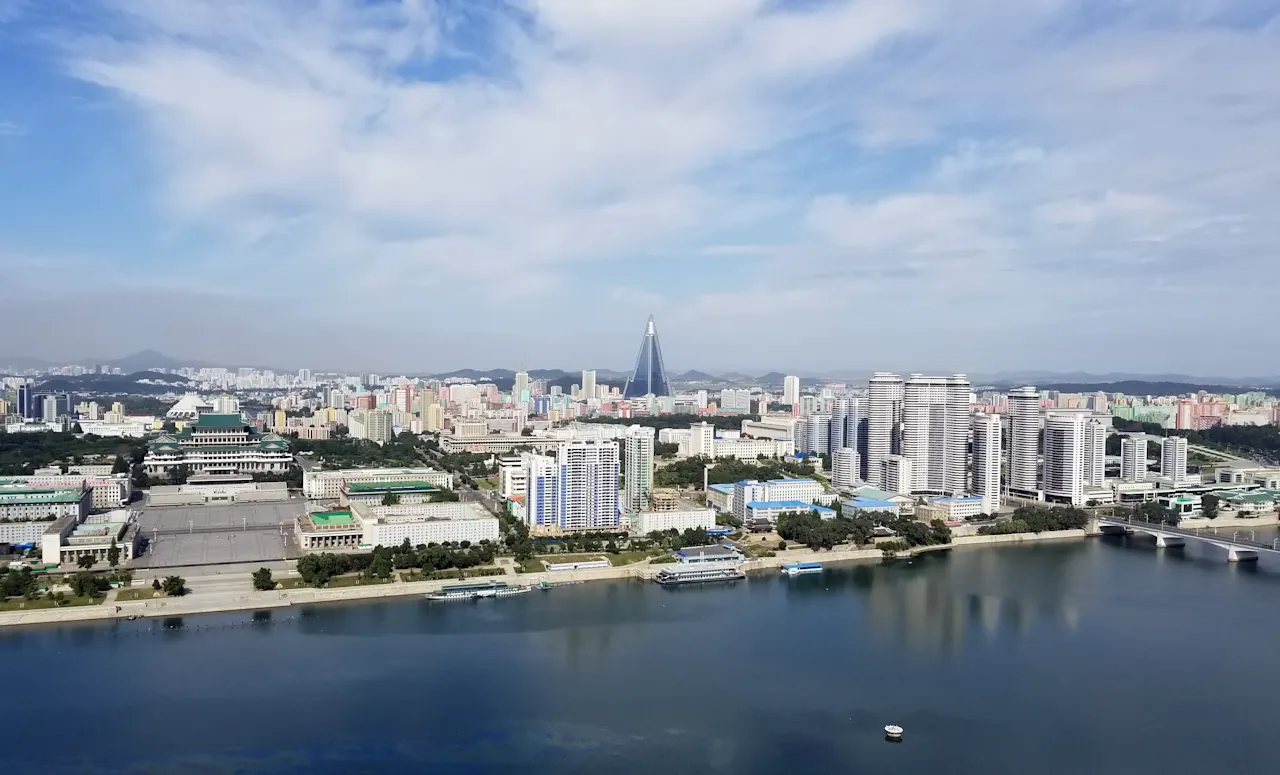
View of Pyongyang from the Juche Tower observation deck.
The Juche Tower is included on most Taedong Tours itineraries, and for good reason: it offers one of the finest elevated views in Pyongyang. An internal elevator whisks visitors up to an observation platform near the top, where you can enjoy an unobstructed panoramic view of the city, including the Taedong River, Kim Il Sung Square, and the Grand People's Study House.
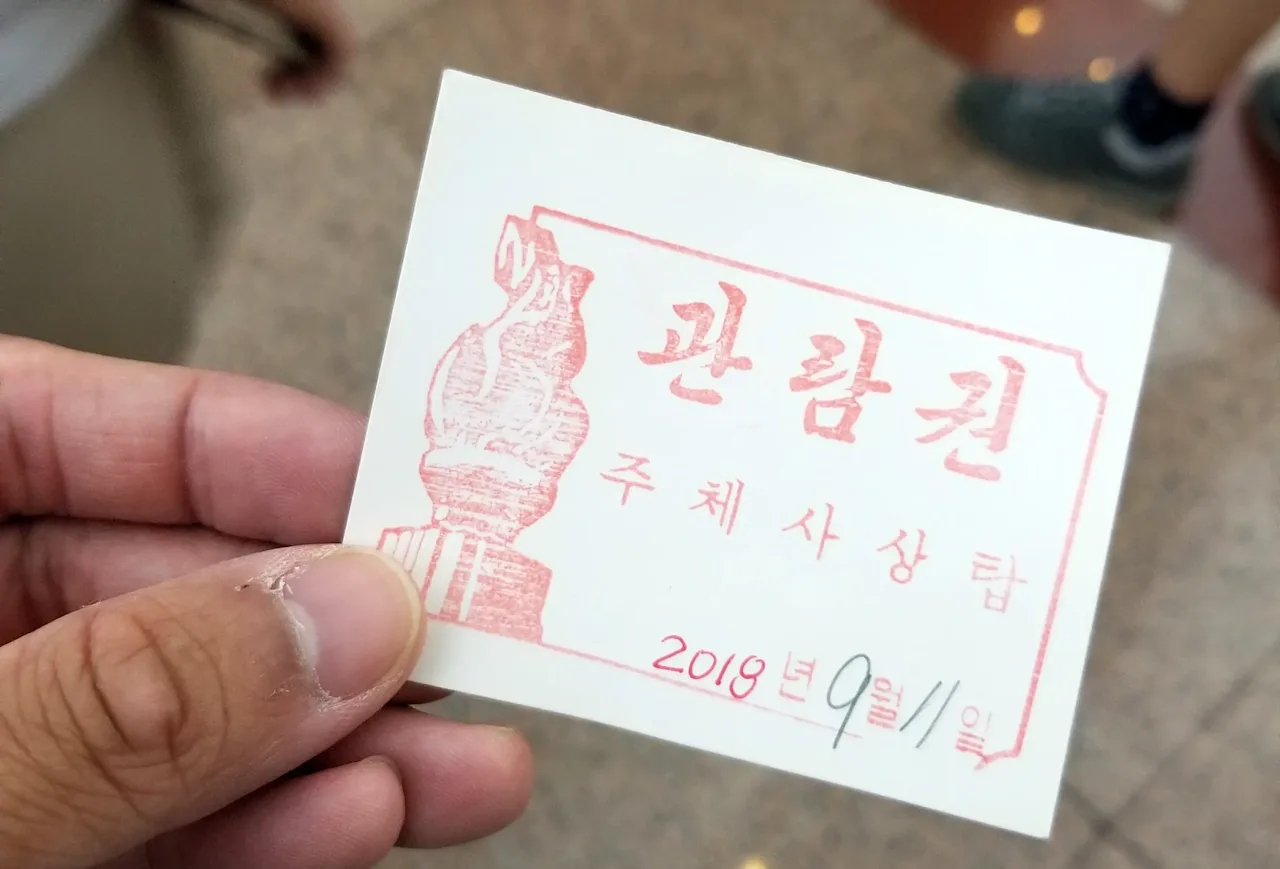
Juche Tower observation deck ticket.
During your visit, you'll receive a guided explanation of the Juche Idea and its influence on the DPRK's identity. Before departing, you're welcome to browse the on-site shop for Juche literature or commemorative souvenirs.
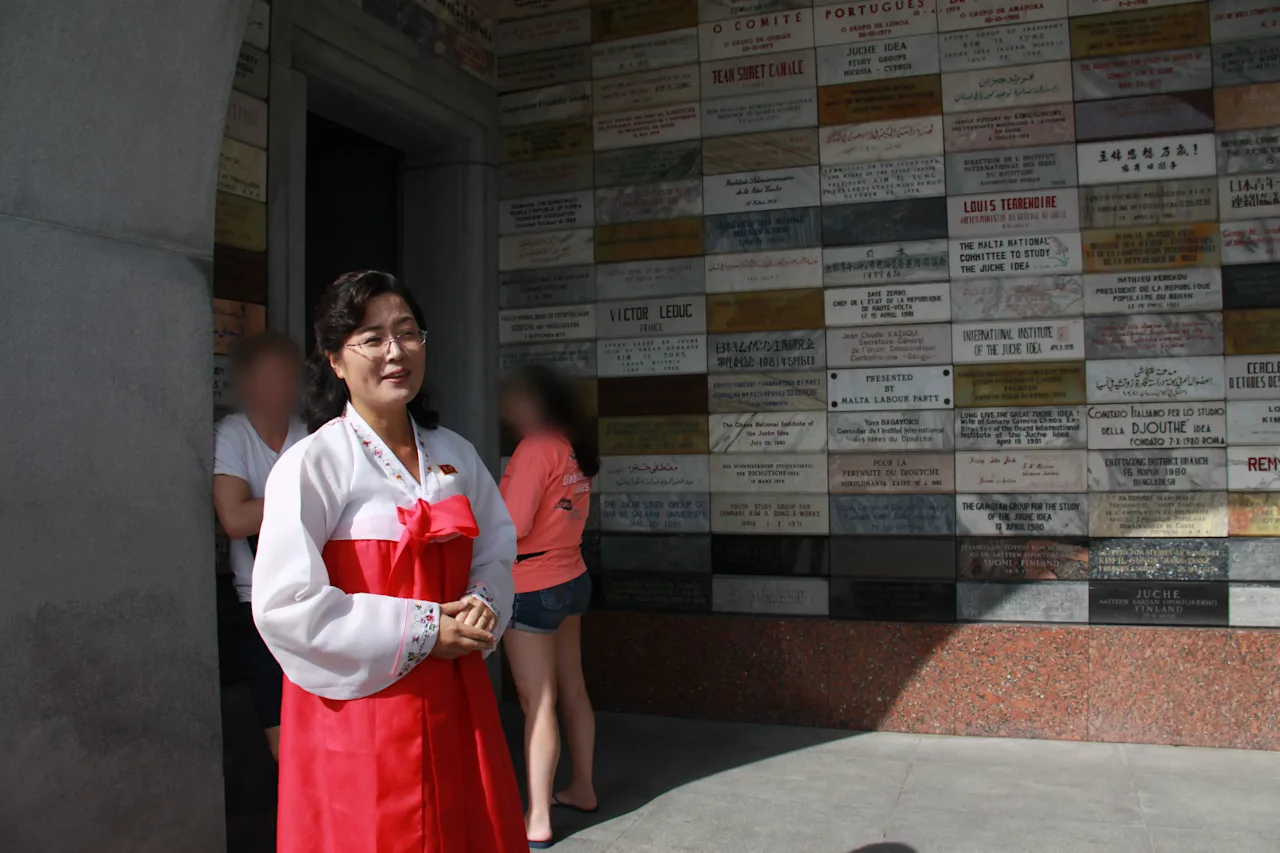
Photography & Conduct
Photography is welcomed here, both at ground level and from the observation deck. Visitors are encouraged to take wide shots of the tower and surrounding monuments. As always, your Taedong guide will advise on etiquette and appropriate behavior, especially when ideological sites are involved.