
The DMZ and Panmunjom
The JSA, towering flagpoles, blue conference halls, and the Concrete Wall reveal the symbols and realities of Korea's continnued division.
Guide Content
Contrary to popular belief, the division between north and south Korea does not follow the 38th parallel, which was only the temporary line set at the end of World War II. The 38th parallel divided the north and the south until the Korean War broke out, with both sides attempting to reunify the country. When the Korean War was halted by the Armistice Agreement of 1953, a new Military Demarcation Line (MDL) was drawn along the forward positions of the Korean People's Army and Chinese People's Volunteers on one side, and the US-led UN forces on the other. To prevent further clashes, a buffer zone four kilometers wide was created along this line, extending two kilometers to the north and south, and is today known as the Demilitarized Zone (DMZ).
Within the DMZ lies the Joint Security Area (JSA), often referred to as Panmunjom (판문점/板門店). However, the JSA is technically not in Panmunjom, which was originally the name of a nearby village where the truce talks were held. Once the Armistice was signed, the JSA was established roughly one kilometer away, with construction beginning in September 1953. Since its completion, all official meetings between the DPRK and the United Nations Command or the south have taken place here. All civilians were relocated from within the DMZ, with the exception of two small villages maintained on either side of the MDL. The original Panmunjom village itself gradually disappeared, though the building where the Armistice was signed remains preserved. In the DPRK, this historic site is today known as the Peace Museum and is included in tours of the JSA.
However, since the DPRK formally announced the abandonment of reunification as a national goal in January 2024, access to the Joint Security Area from the north has been suspended. At present, visits to the JSA are only possible from the south, though this may change again in the future.
Getting There
Back when visits to the JSA from the north were possible, travelers would depart from Pyongyang in the direction of Kaesong on what was aptly called the Reunification Highway. The highway now simply goes by its official name, the Pyongyang–Kaesong Motorway.
On the approach to the Joint Security Area, visitors will notice two massive flagpoles rising above the landscape—one in the DPRK and one in the south. The northern side is home to the famous Kijong-dong flag tower, standing 160 meters tall and flying a 270-kilogram national flag measuring 30 by 60 meters. For many years this was the tallest flagpole in the world, and even today it remains the third tallest, surpassed only by those in Tajikistan and Azerbaijan. Just across the MDL, in Taesong-dong village, the south flies its own flag from a 98-meter tower. Many believe that the DPRK's giant flagpole was built to outdo the south's.
The Conference Rooms
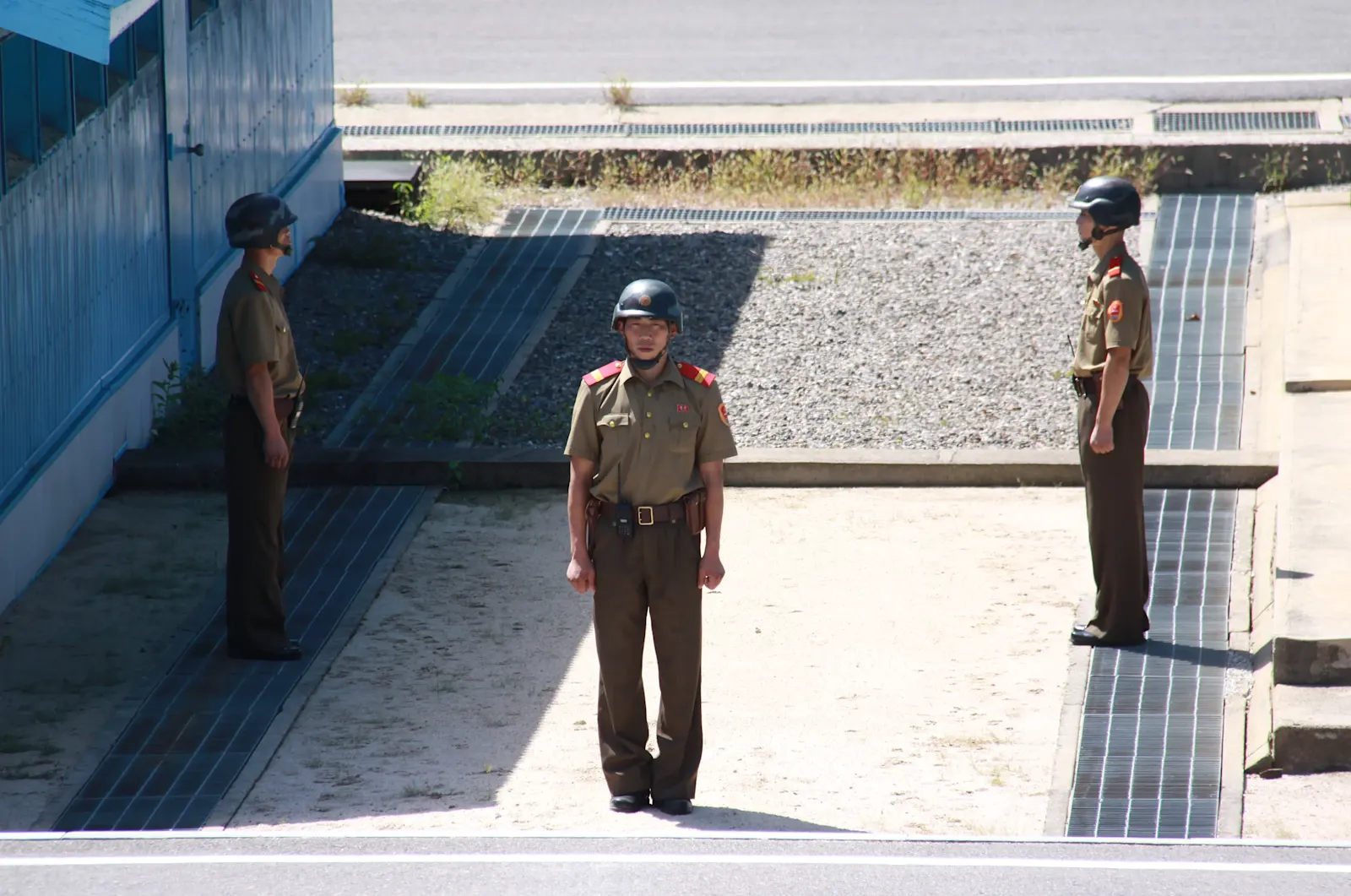
One of the main highlights of the JSA is the row of blue conference halls, known as T1 through T3, where delegations from north and south have occasionally met. Inside the central conference room, a long table sits precisely across the Military Demarcation Line. When visitors are allowed inside, guards are posted at both ends of the room, while tourists are free to walk around and see the space for themselves. Standing here, one can quite literally step from north to south and back north, but always under close supervision, and never through the opposite door.
The Concrete Wall
A short drive from Kaesong brings visitors to one of the DPRK's most striking vantage points over the southern boundary of the DMZ: the Concrete Wall. This imposing fortification, sometimes called the Wall of Division, was constructed by US forces between 1976 and 1979. Stretching more than 240 kilometers across the waist of the peninsula, it stands between 5 and 8 meters high, with a thickness of up to 19 meters at its base. The structure is reinforced with barbed wire entanglements, gun emplacements, and lookout positions, forming part of a larger defense network.
From the DPRK perspective, the wall is seen as evidence of efforts to make the national division permanent. Visiting the site, accompanied by a military guide, offers travelers not only an impressive view of the fortifications themselves, but also a chance to reflect on the continued division of Korea. The journey from Kaesong takes about 45 minutes each way, passing through the surrounding countryside before reaching this seldom-seen landmark.